Pipe networks of every type, up to 1000 mm in diameter
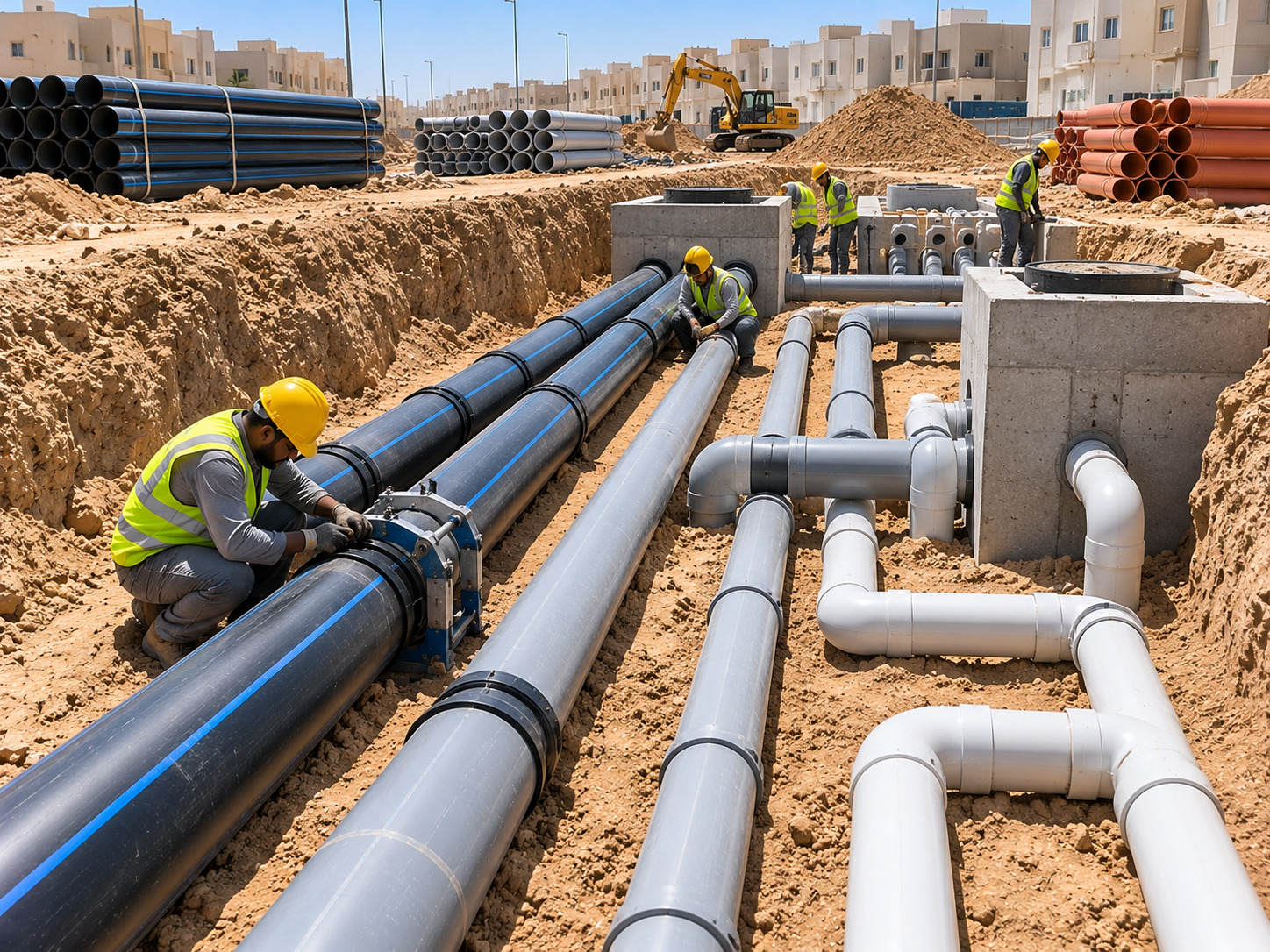
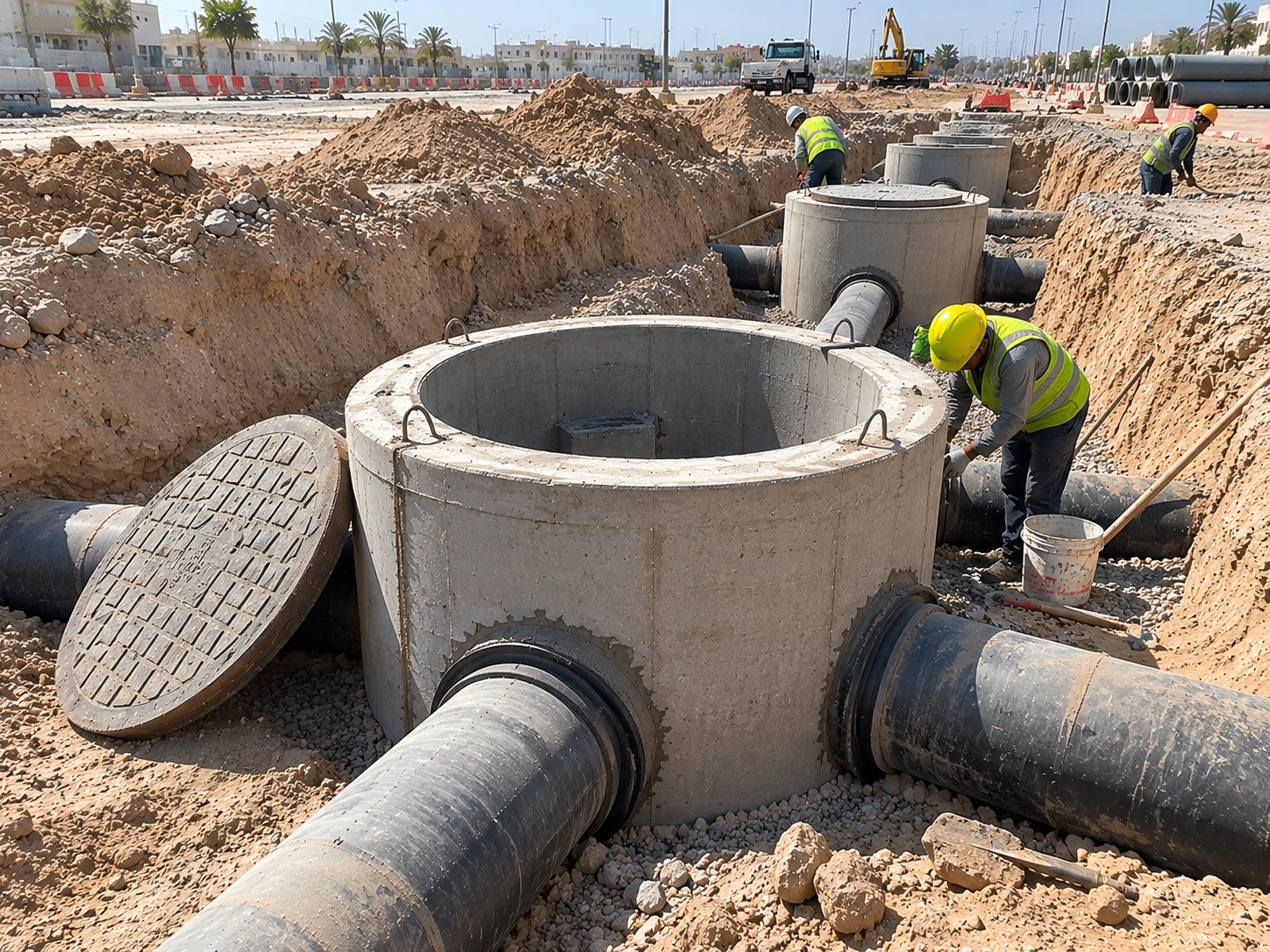
We deliver infrastructure works for developments, complexes and large projects in every city in Saudi Arabia: sewer, fire, irrigation and stormwater networks up to 1000 mm in diameter, in every pipe type: HDPE, PVC, uPVC, reinforced concrete RCP, GRP and steel pipe, with manholes, inspection chambers and pressure and leak testing before backfilling.
Excavation, pipe laying, testing and backfilling, one complete network by one team
Browse our other services in Saudi Arabia
Real stages from network projects we have delivered
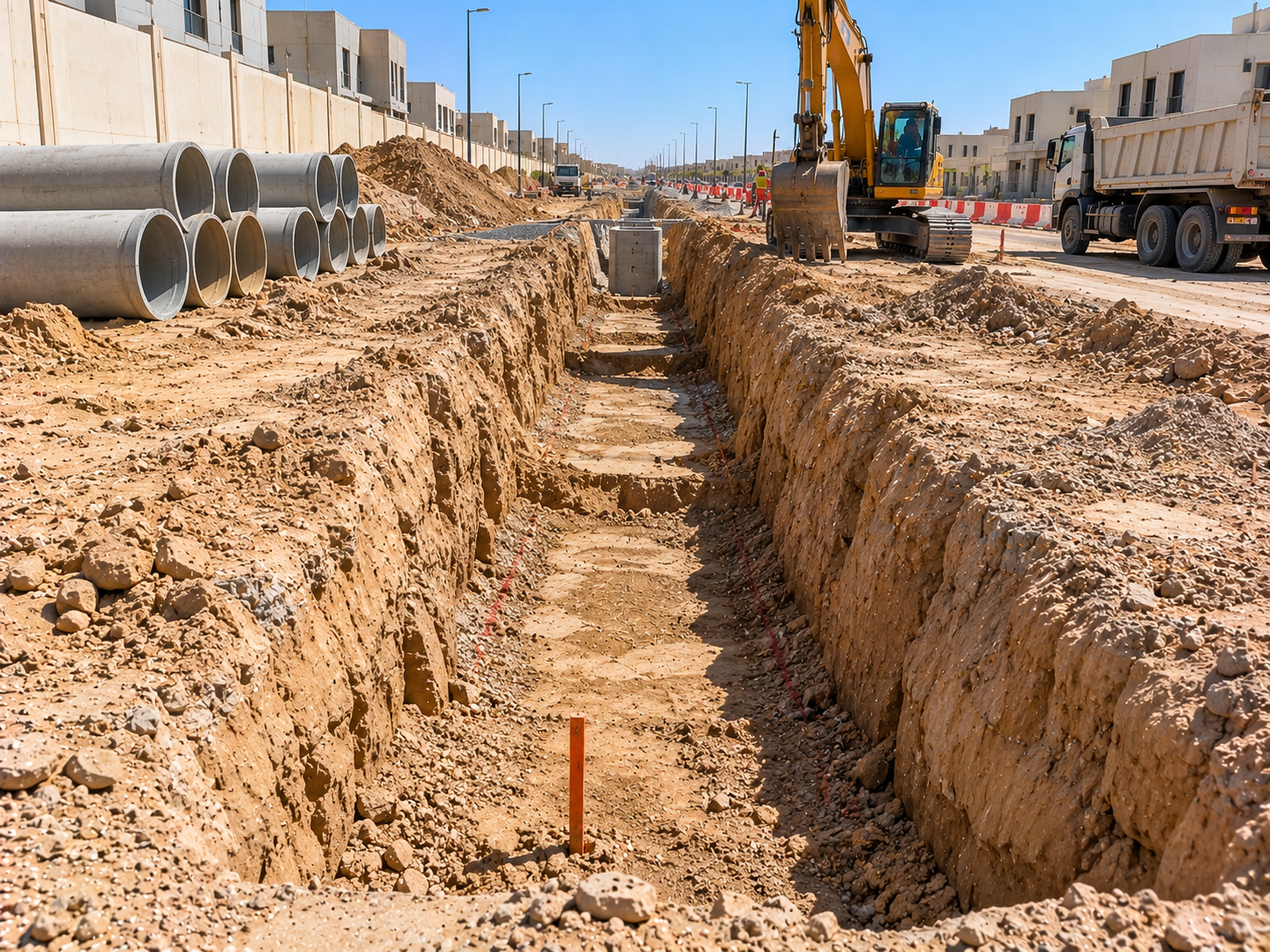
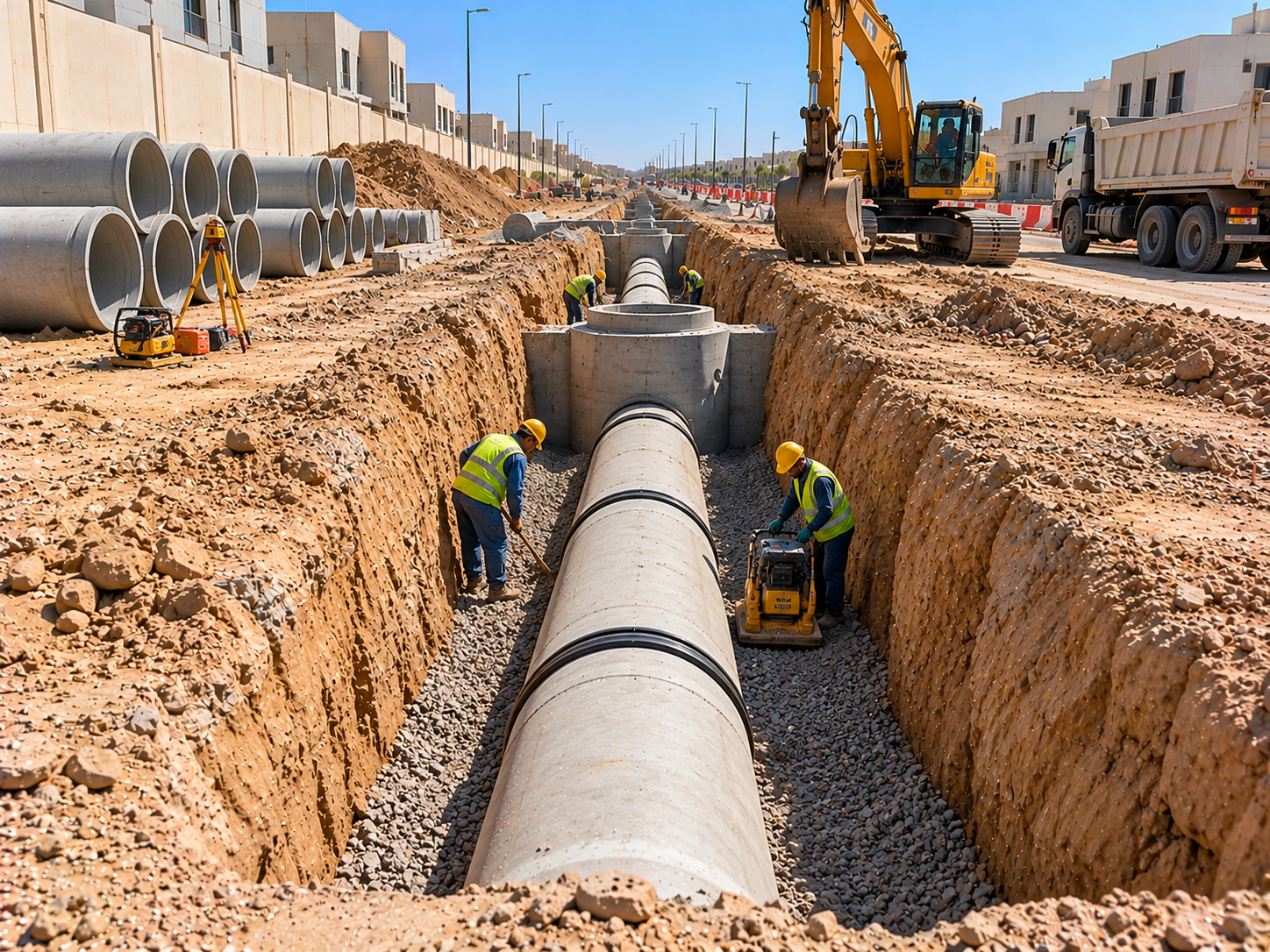
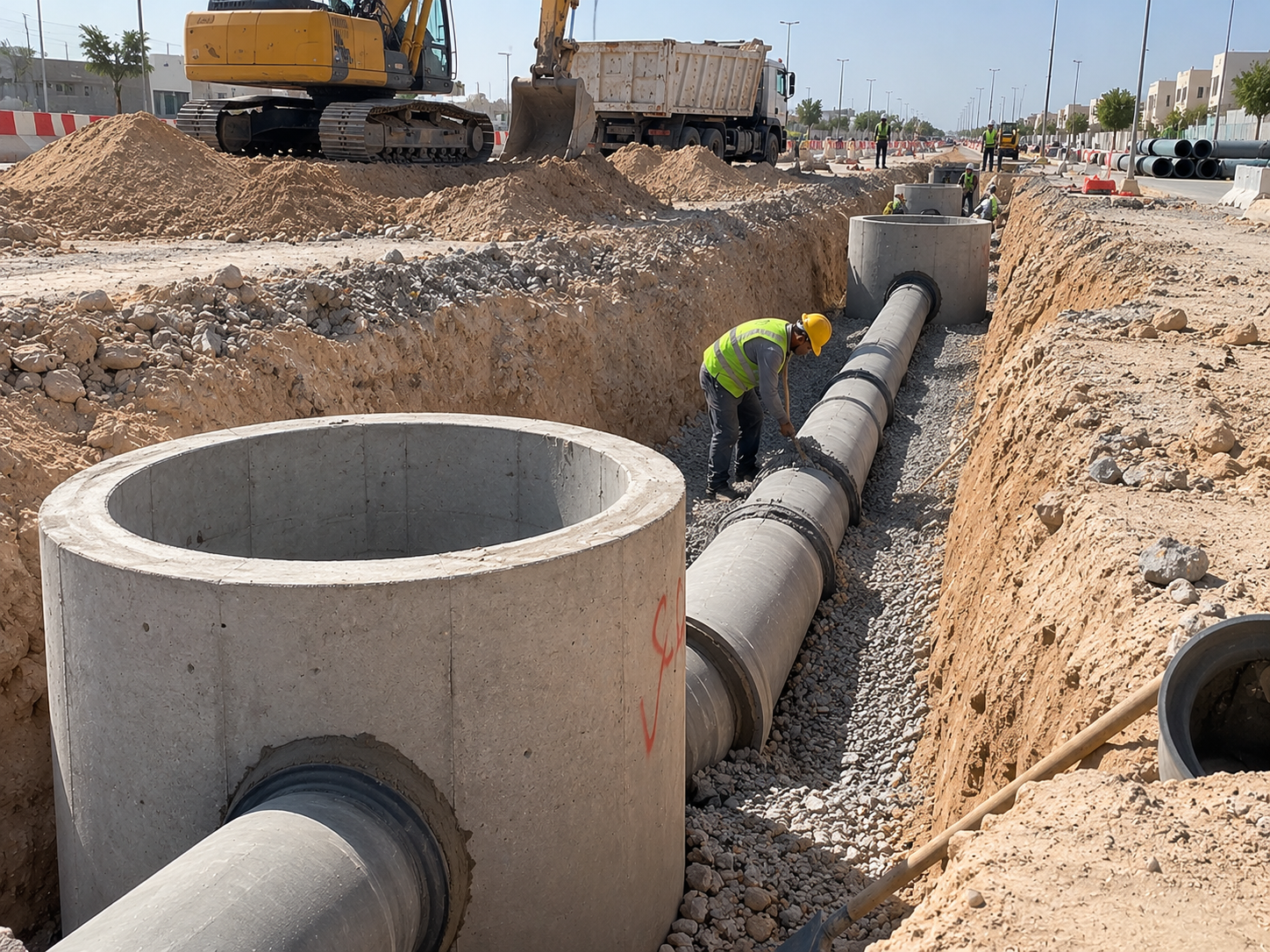
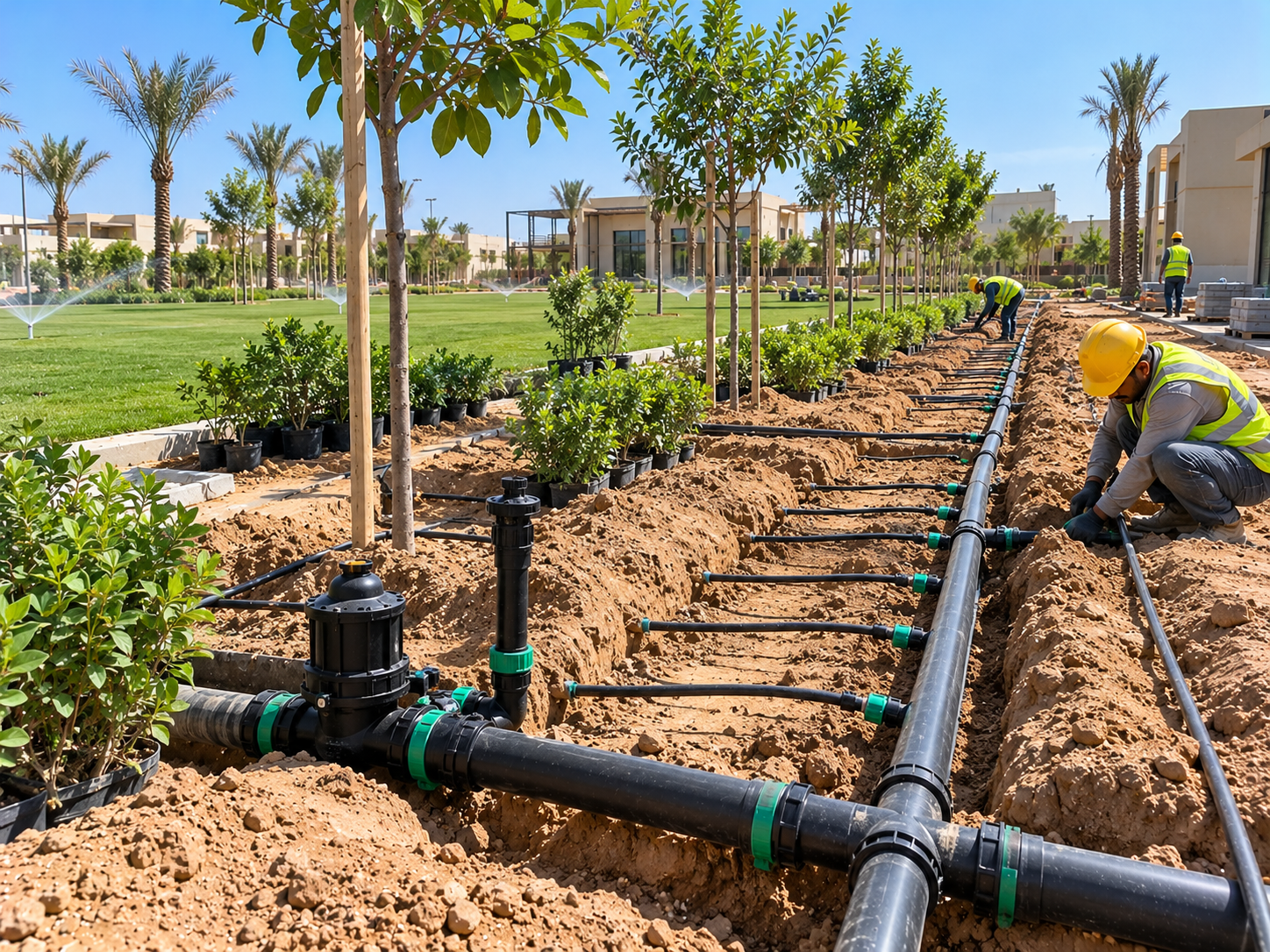
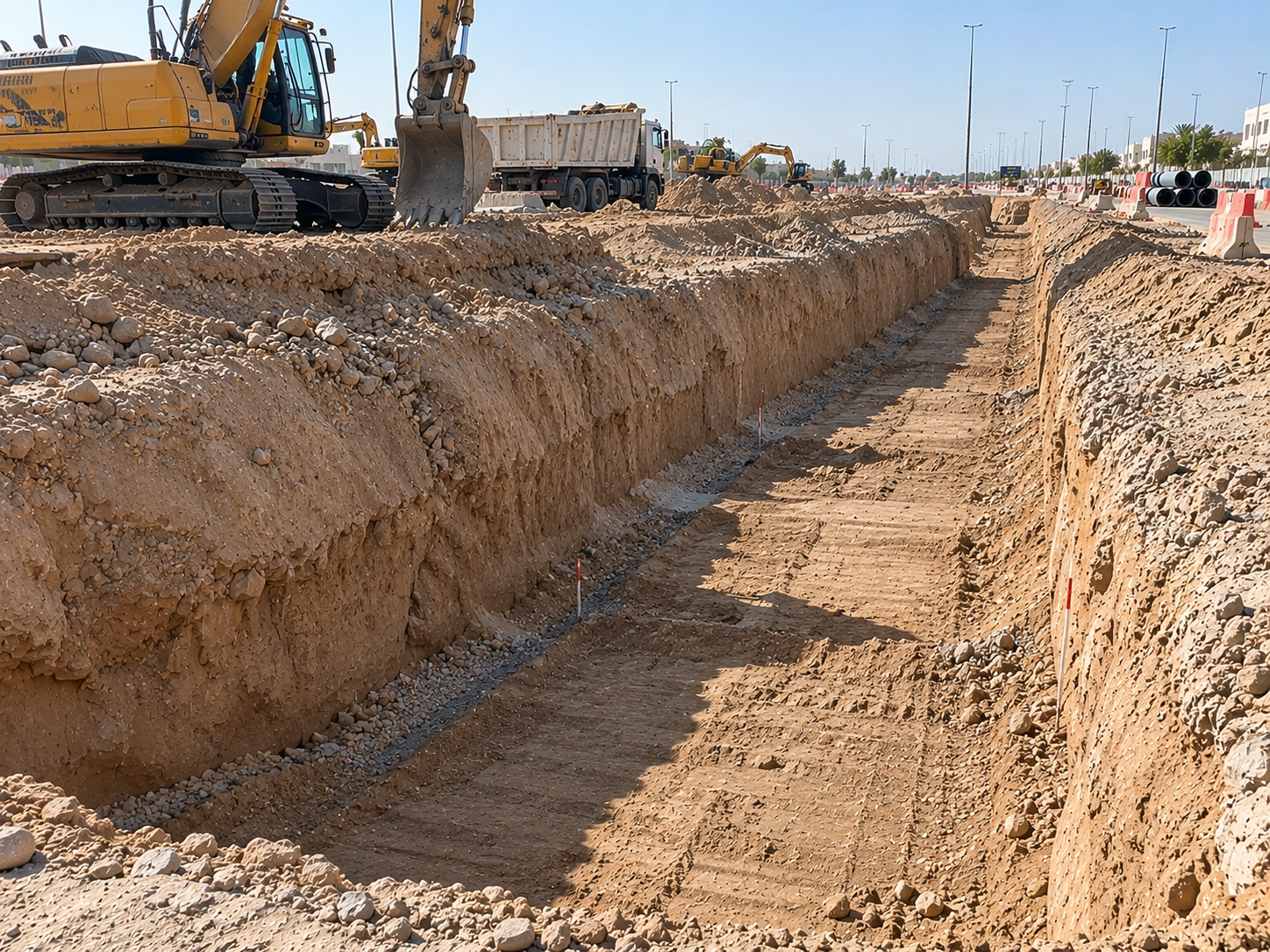
Main sewer line installation
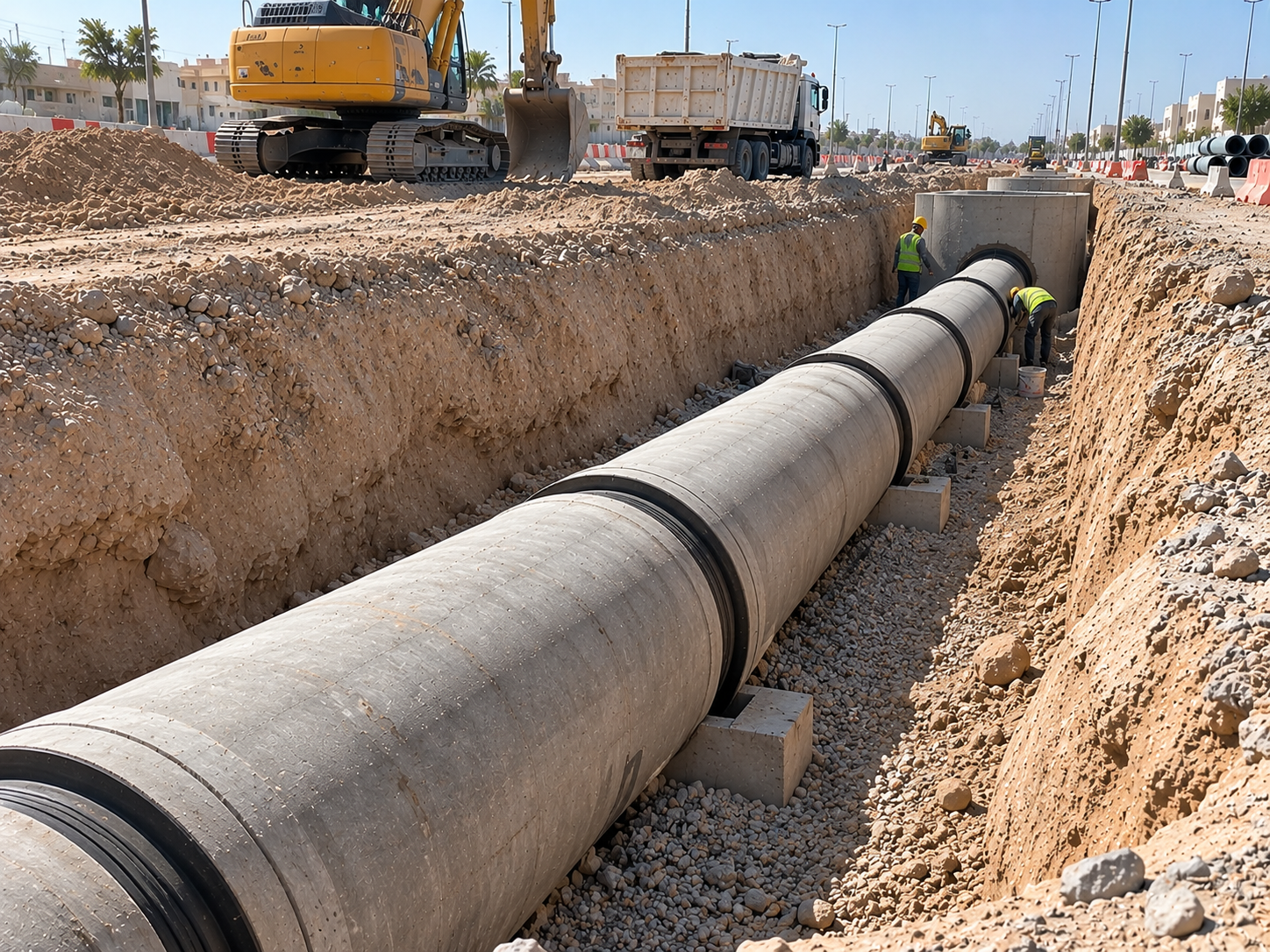
Large-diameter pipe laying
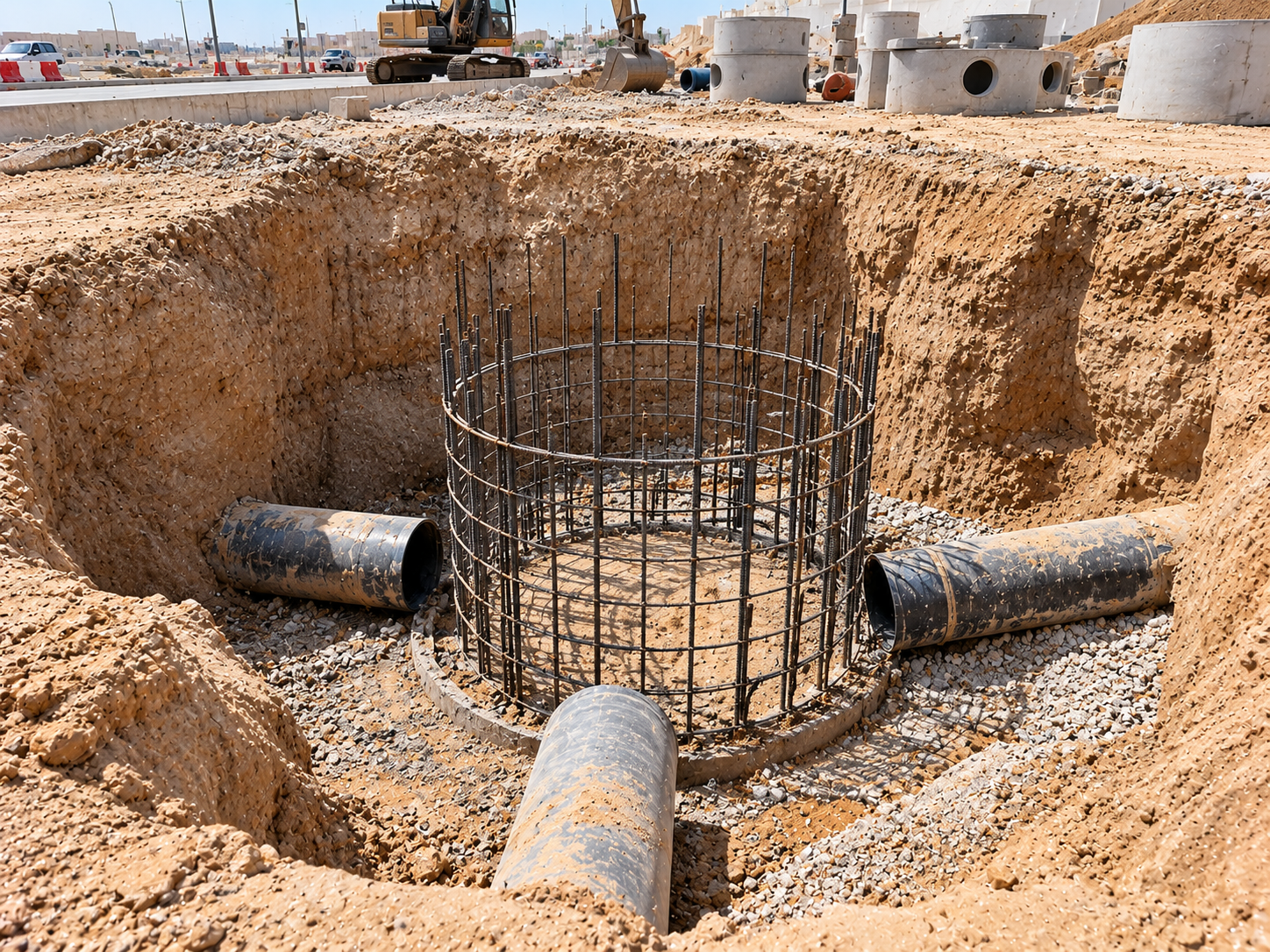
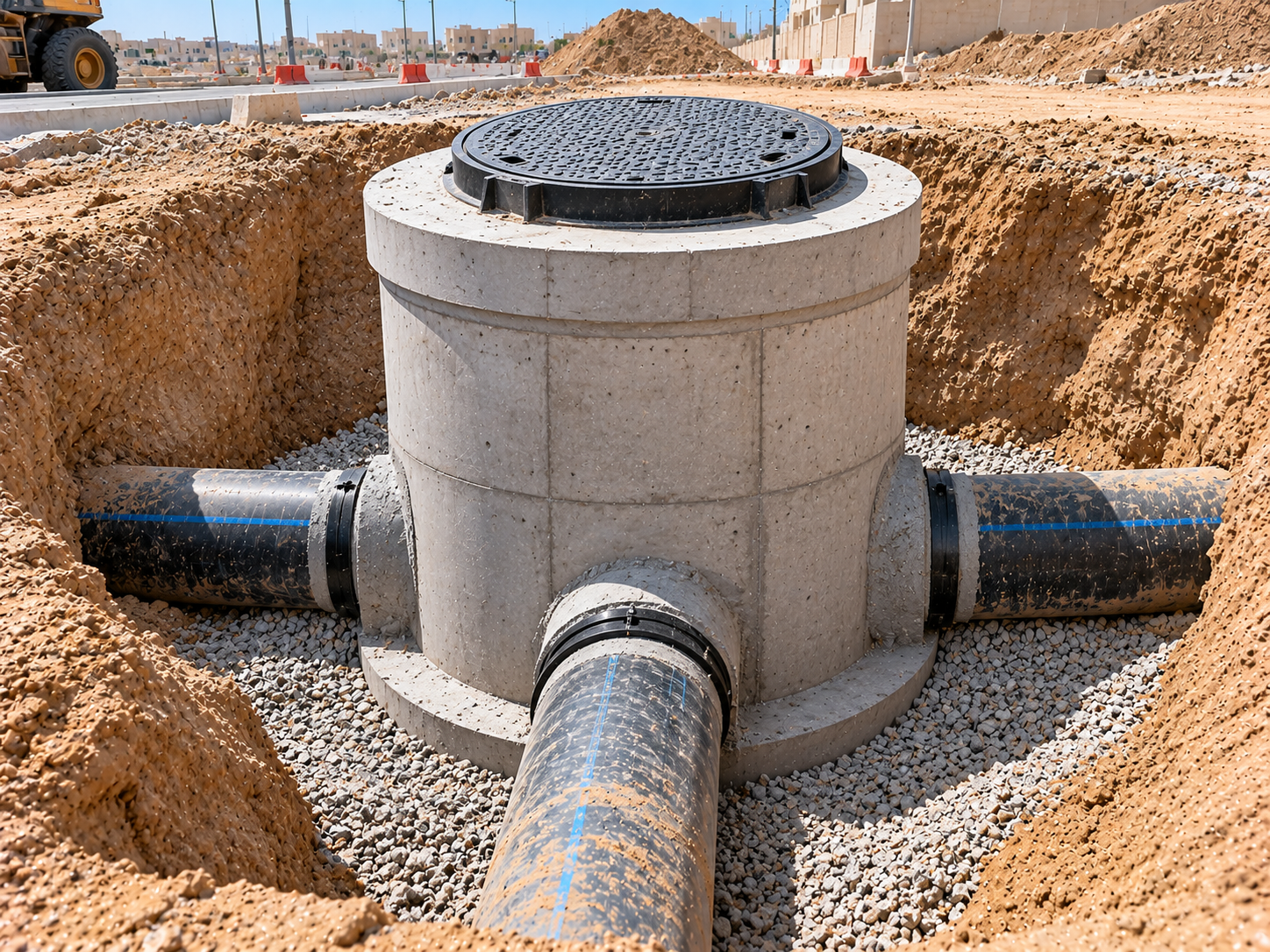
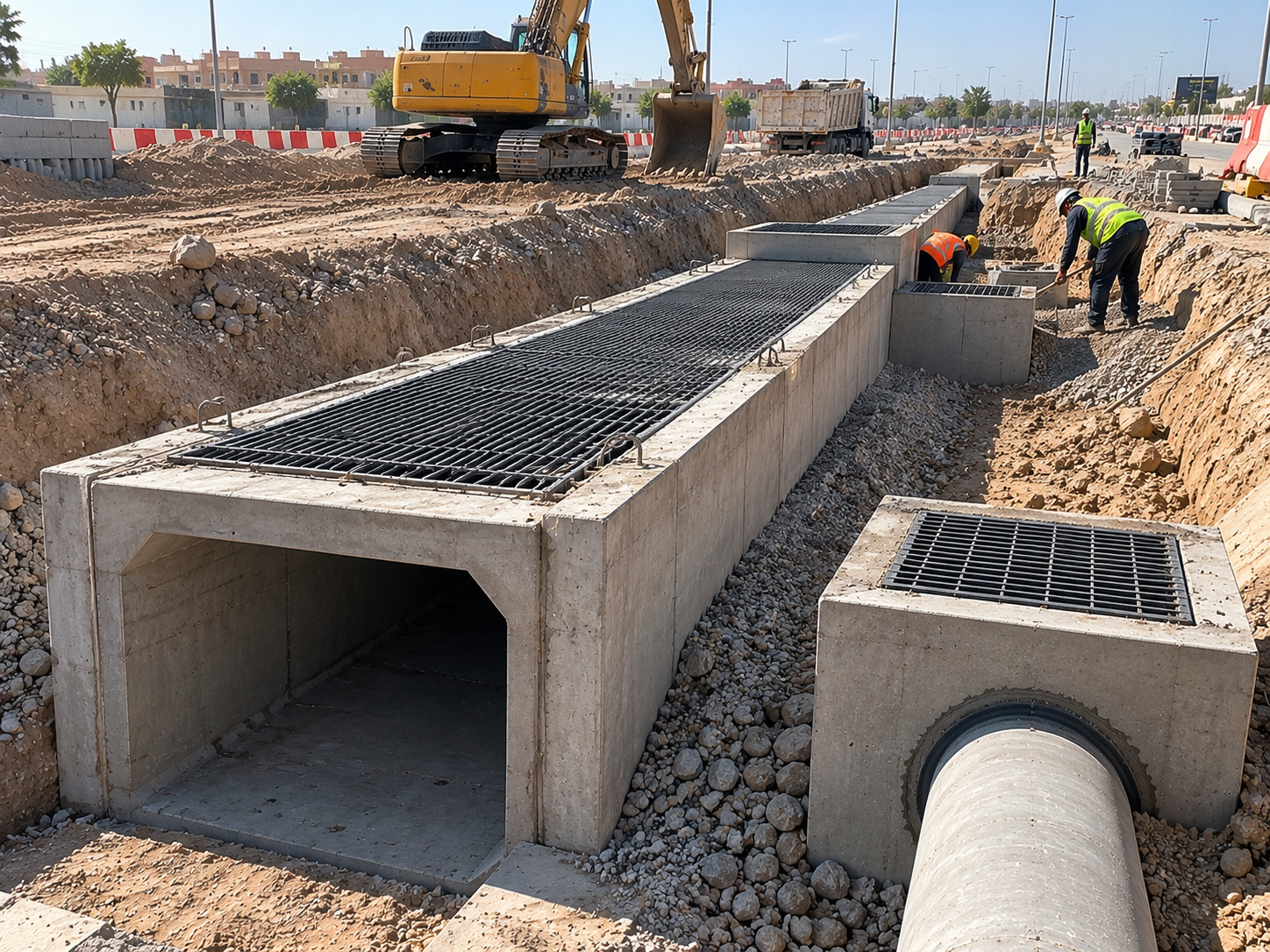
Network manholes
Built to the approved drawings, with every line tested before backfilling
Every pipe type
HDPE, PVC, uPVC, RCP, GRP and steel
Up to 1000 mm
From branch lines to main lines
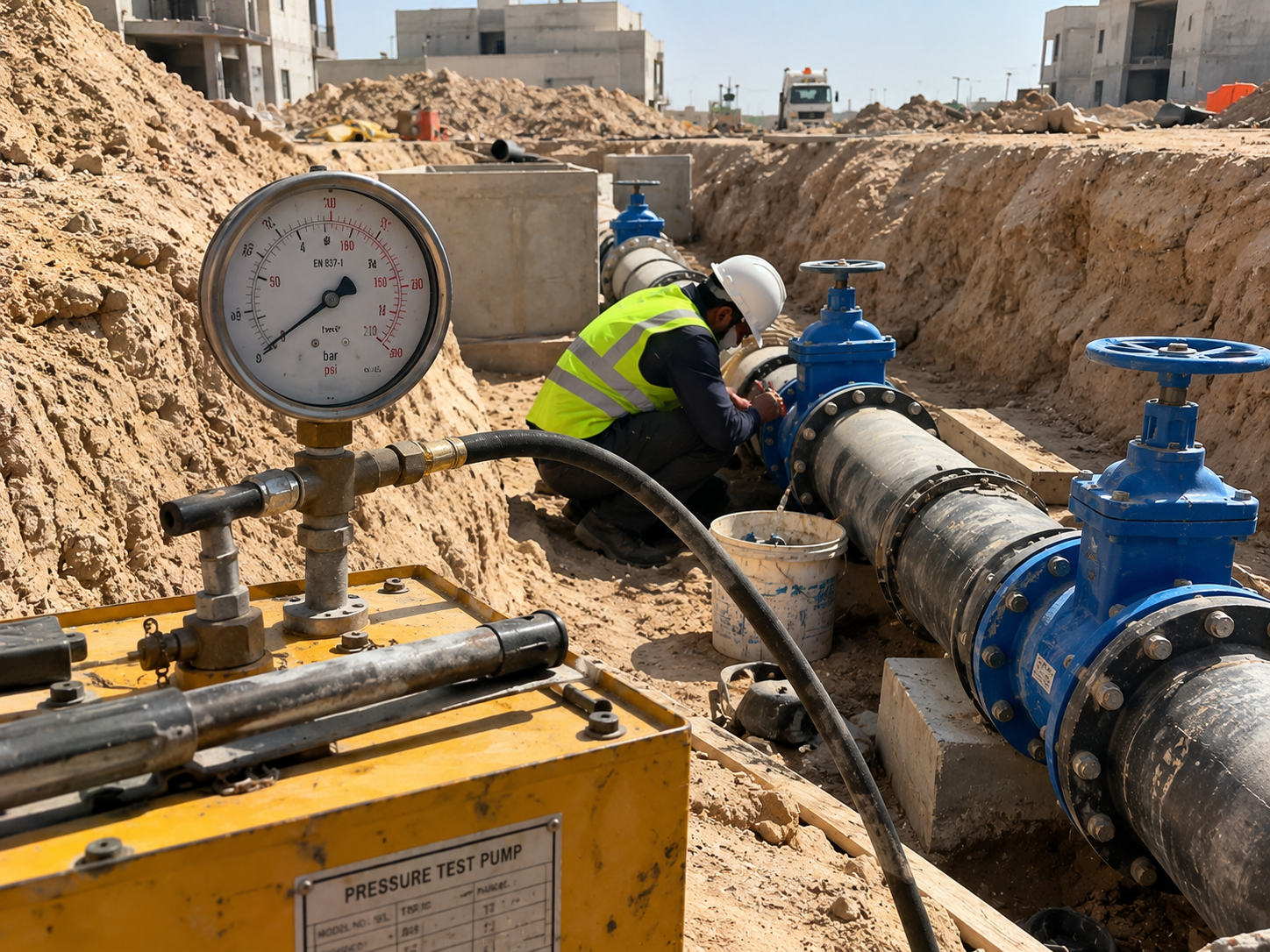
Tested before backfill
Pressure and leak tests on every line
Accurate levels
Survey and slope checks throughout
From first contact to handover: clear steps with no surprises
Contact us
Send the drawings and network scope by WhatsApp or phone
Drawings & quantities
We review routes, diameters and pipe types
Quote & schedule
A clear quote and plan for each network
Excavation & laying
Trenching, pipe laying and manholes
Test, backfill & handover
Network testing, then backfill, compaction and handover
Our headquarters is in Riyadh, and our teams deliver projects across every region of Saudi Arabia with the same quality, engineering supervision and warranty.
The networks buried underground are the foundation of any land subdivision, compound or private project. Nobody sees them after backfilling, yet they decide the comfort of residents and the safety of buildings over the long term. Any mistake in slopes, welding or backfilling shows up later as a blockage, a leak or a sunken road.
This guide explains how to plan sewer, irrigation, fire and water networks the right way. It covers what affects the cost, what to ask of the contractor and how to avoid costly mistakes before you start.
Infrastructure works are everything that supplies a site with basic services below ground. They start before construction or alongside it and finish before asphalt paving and planting. That is why their timing with the rest of the work matters so much, to avoid digging twice.
Real estate developers need it when preparing a new residential subdivision before plots are sold or built on. Owners of residential and commercial compounds need it to connect several buildings to a single network. Palaces and large private sites with annexes, car parks and wide gardens also need a well designed internal network instead of improvised pipework.
Factories, warehouses, schools and shopping centres need it too, where water volumes are larger and the traffic above the network is heavier. In all these cases the idea is the same. A network designed for actual use, execution that follows the drawings and testing before backfilling.
It is best for the team building the networks to work closely with the rest of the site work, such as construction works and tanks. This coordination prevents routes from clashing with foundations, saves time and reduces waste in materials and excavation.
The ideal time is the design stage, before any foundations are poured. At this stage routes can be changed easily and the positions of tanks, pump rooms and connection points can be set. Planning after the buildings are complete usually means breaking floors or changing routes in a less than ideal way. So we advise owners to gather the site master plan, building drawings and landscape drawings in one file before requesting a quotation.
Choosing the pipe type is not a cosmetic decision. Each type has its own installation method, jointing method and resistance to pressure, loads and corrosion. The right choice depends on the type of network, the nature of the soil, the depth of the line and the traffic above it.
| Pipe type | Where it is usually used | Main advantage |
|---|---|---|
| HDPE | Water, irrigation, fire and some sewer lines | Flexible and joined by heat fusion welding, so the network becomes one piece with no weak joints |
| uPVC and PVC | Sewer, branch lines and irrigation | Light and easy to install, with a smooth inner surface that helps flow |
| RCP concrete | Large diameter stormwater and main sewer lines | Carries high loads above it and suits greater depths |
| GRP | Main lines in aggressive soil | High corrosion resistance and lighter than concrete |
| Steel | Exposed fire lines and road crossings | High strength, needs protection from rust |
Pressure networks such as water and fire need pipes and joints that carry the operating pressure without leaking. In gravity networks such as sewer and stormwater, what matters most is the correct slope, a smooth inner surface and pipe strength against the weight of soil and vehicles.
On sites with salty soil or a high groundwater level, corrosion resistant materials are preferred. On sites with truck traffic above the line, the pipes need extra protection, a greater depth or a stronger type.
Manholes, inspection chambers, valves, fire hydrants and stormwater inlets are part of the network itself. Their quality, the level of their covers and the way they connect to the pipes decide how easy maintenance will be later. So ask for the quotation to state the type and specification of every accessory clearly, just like the pipes.
Do not accept a change of pipe type during execution without written approval. Some materials look alike but differ in thickness and pressure rating. Ask to see material certificates or technical data sheets before supply. This simple step protects you from lower quality materials whose problems may only appear after operation and backfilling.
Laying networks goes through a sequence of stages, and each stage depends on the quality of the one before it. Skipping or rushing any step shows its effect after backfilling, when repairs become harder and more expensive.
The deepest networks, such as sewer and stormwater, usually go in first, followed by those closer to the surface, such as water and irrigation. This prevents digging over a line that has just been laid. Coordinating the networks with excavation, asphalt and pavement works saves the owner considerable time and cost.
We always recommend keeping the as built drawings. They are the only reference for any future expansion or maintenance and they prevent random digging in search of a buried line.
It is also useful to place a warning tape above the pipes during backfilling. This tape alerts any team digging later that there is an existing line below, so they stop before reaching it and breaking it.
There is no fixed price per metre of network that works for every project. The cost depends on a set of factors that vary from site to site. Understanding these factors helps you compare offers fairly and avoid a cheap offer that hides missing items.
Does the offer include supply of materials or installation only. Does it include backfill material, compaction, surface reinstatement, testing and as built drawings. These items may be missing from some offers, so the offer looks lower and the costs appear later.
So always ask for a detailed bill of quantities that shows every item with its unit and quantity. Compare offers item by item, not only by the final total. A clear offer protects you from disputes and makes any later change calculated fairly.
Early planning is the biggest source of savings. Grouping networks in shared corridors reduces the amount of excavation and backfill. Laying the networks before asphalt and pavements prevents breaking them later. Choosing the right material for each line instead of the most expensive material everywhere saves money without weakening the network.
The hardest thing about networks is that their defects disappear under the soil. That is why supervision during execution matters far more than inspection after completion. As the owner, you have the right to ask for proof that every stage was carried out properly.
Compaction testing of the backfill layers, especially under roads and car parks. Inspecting manholes from the inside to make sure they are clean and free of debris. On main sewer lines, a camera inspection can be requested to confirm there is no deformation or blockage.
Avoiding these mistakes does not need complex technology. It only needs commitment to the steps and engineering supervision present on site.
If you cannot be on site every day, ask for a short report at each stage showing what was done, which tests were carried out and their results. A written report with photos saves you repeated visits and remains a reference in any dispute or warranty claim.
The Kingdom is vast, and its soil and climate vary a great deal from one region to another. A network that works on one site may need adjustments on another. That is why the study of any project starts with understanding the ground and the weather before choosing materials and methods.
In Riyadh, Qassim and Al Kharj the weather is hot and dry, and the soil is often firm or rocky in some districts. High heat affects plastic pipes left exposed before installation, so they must be stored in the shade. Heat fusion welding needs settings that take the air temperature into account. Rain here is light, but it can come heavily in a short time, so stormwater networks need a design that can handle these surges.
In Jeddah, Yanbu, Dammam, Al Khobar and Jubail humidity is high and groundwater may be close to the surface. Soil on some sites is salty and affects metals and ordinary concrete. Here corrosion resistant materials are preferred and concrete manholes are protected with insulating coatings. Excavation may need continuous dewatering so the trench stays dry during pipe laying and testing.
In Abha, Khamis Mushait and Al Baha the weather is cooler, rainfall is higher and the terrain is sloping. This makes stormwater drainage a major priority, and excavation in rocky ground needs breaking equipment. Steep slopes require calculating the flow velocity inside the pipes and anchoring the lines well.
Always ask the contractor how they will deal with the specific nature of your site. A contractor who offers the same solution for every city has not studied your site yet. At Yam Integrated Construction every study starts with a site visit to understand the soil and levels before proposing the pipe type and the excavation and backfill method. Our teams work from Riyadh across the cities of the Kingdom with the same approach, adapting the details to each region.
The weather also affects the work schedule itself. In the hottest months it is better to carry out welding and testing in the cooler hours. In rainy seasons open trenches must be protected from water and mud getting in.
Choosing an infrastructure contractor is a decision that stays with you long after handover. A good network goes unnoticed, while a poor one reminds you of itself with every blockage or settlement. So judge the contractor on how they work, not on price alone.
A good quotation states the scope of work clearly for each network. It sets the type, diameter and approximate length of the pipes and the number of manholes and valves. It explains whether it covers supply, excavation, backfilling, testing and surface reinstatement. It states the payment method linked to completed stages and the warranty terms. Treat any item that is not mentioned as not included until it is written down.
We start with a site visit and a review of the drawings, then submit a written quotation with clear items. After signing, a specialist engineer follows the execution on site from the survey through to testing and backfilling. We send you regular photos of every stage so you can follow your project from your office. We use approved materials and hand over the test results with a written warranty in the contract.
Because we also carry out excavation, concrete works, concrete tanks and asphalt paving, the whole site is the responsibility of one team. This reduces clashes between contractors and keeps responsibility clear. Our head office is in Riyadh and we work in Jeddah, Dammam, Madinah, Abha and other cities. You can see examples of our projects or contact us to arrange a site visit.
After handover we stay in touch with you throughout the warranty period. We recommend inspecting manholes and cleaning stormwater inlets before the rainy season and after any nearby construction work so the network keeps running efficiently.
Many disputes on network projects come from a specification that was never written down. The client understands one thing, the contractor builds another, and both believe they are right. Ask for the technical specifications to be part of the contract rather than something said during the site visit. These are the items most worth seeing in writing.
The contract should state the bedding material under the pipe, the surround material above it and how it is compacted in layers. An excellent pipe will still fail if it is laid on stones or backfilled with soil full of hard lumps. The contract should also give the approximate depth of the lines and the safe spacing between parallel networks, especially between sewer and water lines.
It is not enough for the contract to say the network will be tested. Ask it to name each test, its duration, how it is recorded and who attends. A pressure test on a fire network is different from a leak test on a sewer and from a camera survey of large lines. With these items written down, handover becomes easy because you compare what was built with what you agreed.
At Yam Integrated Construction we attach the specification schedule to the quotation itself. You know before signing exactly what you will receive, and you can share it with your own engineer or consultant to review.
Contracts often forget what happens above the trench after backfilling. Ask for the layers to be reinstated over each line to be named, along with how they are compacted, so the surface returns to its original condition or better. A carelessly reinstated surface settles after a while and the line shows clearly through the asphalt or paving.
If you are unsure about any item, ask for its technical reason. A good specification has a clear reason that an engineer can explain in plain words. A specification nobody can explain has usually been copied from another project.
A rushed start on a network project costs more than it saves. An excavator that starts before preparation is complete may cut an existing line or dig to the wrong level, and then the whole job is redone. That is why we use a clear preparation checklist and review it with the client before any digging.
If a building contractor or electrical contractor is on site, each party must know the network routes before starting. Everyone agrees who is responsible for protecting the lines once laid. A safe route is set for heavy machinery so it does not load the lines before backfilling is complete.
If the project is occupied, such as an existing residential compound, residents need to know the work areas and hours. We set safe alternative entrances and put clear barriers around trenches. This simple preparation prevents a great deal of disruption and many accidents.
Once this list is complete, the work moves at a steady pace. Sudden stoppages and repeated digging drop, and trenches stay open for the shortest possible time.
In areas that see heavy rain it is better not to leave trenches open during the rainy season. In the summer of the central region we arrange working hours to protect the crew and to protect some pipes from heat during welding and installation. We review this timing with the client as part of preparation so the schedule is realistic.
We also ask the client to name one person for the site team to deal with. Many voices in daily decisions confuse the work. A single point of contact makes approvals faster and information clearer for everyone.
When three quotations arrive for the same project, the totals usually differ clearly. The common mistake is to pick the lowest straight away. The gap is often not profit at all but missing items, weaker specifications or quantities estimated differently. Here is a simple way to compare fairly.
Put the quotations into one table. Make each row an item such as pipe supply, trench excavation, bedding, backfill, manholes, valves, testing and surface reinstatement. Then note what each quotation says against each item. You will quickly find that some quotations leave out whole items.
Some quotations price by linear length of line and others as a lump sum for the whole project. A rate per length means you need to know who measures the final quantities and how. A lump sum needs a precisely defined scope so extra items do not appear. Neither system is better in every case. It depends on how clear the drawings are.
Also compare payment terms and how they link to stages, warranty terms and how long the quotation is valid. Check whether it mentions engineering supervision, test reports and as built drawings. These items do not show in the total, yet they make the difference after handover.
If an item is unclear, ask for a written clarification before signing. A serious contractor welcomes the question because it protects both sides.
If one quotation is far lower than the rest, ask directly why. If a quotation does not name the pipe type or simply says according to standard practice, ask for specifics. General wording opens the door to disputes later.
Ask each contractor to walk you through their quotation in a short meeting. The way they explain the items shows how well they understand the project. A contractor who visited and studied the site answers confidently, with details that belong to your site and not general talk that fits any project.
Network works are among the most hazardous in contracting because they combine deep excavation, heavy plant and work in tight spaces. Safety here is not a formality but part of the quality of the work. A trench that collapses does not only injure workers. It damages pipes and delays the project.
The deeper the trench or the weaker the soil, the greater the risk of the sides collapsing. Trenches are protected either by suitable side slopes or by steel shoring panels. In sandy coastal soil, shoring is even more necessary. Excavated material is never left on the trench edge because its weight presses on the sides.
Existing sewer manholes can contain harmful gases. No worker goes down before the manhole is ventilated and the air is checked with a dedicated gas detector. A colleague stays at the top for the whole time with a safety line. This rule holds however short the task.
Helmets, safety boots and reflective vests are basic every day. Face shields and heat resistant gloves are added for butt fusion welding of HDPE pipes. In the central region's summer we arrange working hours and provide water and shade, because heat stress is a real danger.
Cutting a power cable or gas line during excavation is a serious incident. We expose doubtful routes by hand digging before the excavator moves in, and we mark existing lines clearly on the ground.
Ask any contractor about their safety plan before signing. The way they answer reveals a lot about how they run the whole site. At YAMIC the site engineer checks these rules daily as part of engineering supervision.
There must be a first aid kit on site and an emergency number everyone knows. Every worker knows what to do if a trench side gives way or a gas smell appears. These simple details save time in any emergency and protect lives above all.
Good safety does not slow the work, as some people think. An organised site where everyone knows their place and role moves faster and with fewer mistakes. One stoppage caused by an accident costs far more than all the preventive measures together.
Networks sit beneath everything else on a project. Above them are roads, pavements and green areas, and beside them are building foundations and power cables. Without good coordination you end up breaking new asphalt to reach a pipe someone forgot. This is one of the most costly and disruptive mistakes.
Every point where a network will pass under a future road must be prepared before paving. The best solution is to lay empty protective sleeves at these points even if the need is not certain. They cost little at the time and save you breaking the road later.
Manhole covers and valve boxes must sit exactly at the final road level. A raised cover hits wheels and a low one collects water and breaks the asphalt around it. We agree final levels with the road contractor before fixing the covers and adjust them after the layers if needed.
Drain outlets from each building and water entry points must line up with the external network. We review them with the building contractor before foundations are poured. Any change to a building position or floor level is reported at once because it changes the slopes.
The roots of some trees search for water and can enter sewer joints over time. Distance is kept between large trees and sewer lines. Irrigation outlets are coordinated with the garden design before the lines are laid.
This coordination is easier when excavation, networks and paving are with one party. That is why at Yam Integrated Construction we prefer to plan the whole external phase together and show you its sequence before starting. You can see examples in our projects.
Before each main stage we bring the parties together for a short meeting on site. We review routes and levels and what will start and finish. What is agreed is recorded in minutes sent to everyone so nobody relies on memory.
When the road contractor is a different party, make sure they receive the network routes in writing from the network contractor before the layers start. This written handover makes responsibility clear if a line is damaged during compaction or laying.
Not every project is empty land. Many requests come from existing compounds, palaces and facilities that need a network extended, a tired line repaired or an old section replaced. Working on a network that is already in service calls for a different approach from new construction.
The first step is to know the condition of the current network accurately. This is done by opening manholes, checking levels and running a camera inside the lines where needed. The camera reveals cracks, blockages, roots and sagging pipes without digging. After diagnosis it becomes clear whether a local repair is enough or the line needs replacing.
In an occupied building, drainage and water cannot be stopped for long. We plan temporary diversions before starting. On sewers we may use pumps to carry flows around the section under repair. On water and fire networks we isolate the section with valves and agree the shutdown time with the owner in advance.
When new buildings are added to an existing compound, we confirm the main line can carry the extra load. Sometimes the better solution is a new independent line rather than loading the old one beyond its capacity. Connections to the existing network use couplings suited to the old pipe type.
On existing sites the network lies under paving, asphalt and gardens. The quotation includes reinstating the surface with the same material as far as possible. We photograph the site before starting so the comparison afterwards is clear.
Working on existing networks takes more patience and precision than new work. A contractor who proposes full replacement before any inspection is not giving you the whole picture.
Work on an old network often uncovers lines that appear on no drawing. We record every line we find and add it to the final drawings. You come out of the repair project with a clearer map of your whole network, not just the part that was fixed.
In large palaces and compounds we often suggest carrying out repairs in phases. We start with the sections that affect residents most and then move to the rest. The site keeps running normally throughout without long interruptions.
Handover is the last chance to spot any issue while the contractor is still on site. After backfilling and paving, every repair becomes harder and more expensive. So do not treat handover as a quick walk around. Make it an organised review against a written list.
Years later you may need to add a building, dig to plant a tree or repair a line. Without an accurate drawing of the network routes, every excavation becomes a gamble. Keep these drawings somewhere safe and give a copy to whoever handles maintenance.
If issues come up at handover, record them in minutes signed by both parties with a date for closing them. Handover is not final until they are all closed. This protects your rights without holding up the rest of the project.
At Yam Integrated Construction we hand over these documents together in one file. We walk the site with you or your engineer point by point before the handover is signed.
Before signing, it is best to run the networks with real water. Open the water valves, test the irrigation system, pour water into drainage points and watch it flow to the last manhole. This trial reveals what a surface inspection cannot. The contractor's engineer and the owner's representative attend together so the result is recorded for both.
If you have a consultant or independent engineer, invite them to the handover. Their neutral eye reassures you and the contractor alike. We welcome their presence because early comments serve everyone and shorten discussions after handover.
A buried network does not show its faults on handover day. Some problems begin after the first rainy season or once every building is in use. So it helps to understand what the warranty covers and to know the early signs worth watching.
What matters is that these limits are written clearly in the contract. A written warranty is better than a general promise each side reads its own way.
| Sign | Likely cause |
|---|---|
| Asphalt or paving sinking along a line route | Poorly compacted backfill or a leak washing out the soil |
| Sewer smell near a manhole or building | Weak manhole protection or an open joint |
| Slow drainage in a building | Incorrect slopes or the start of a blockage |
| Water pooling after rain | Drain inlets at the wrong level |
| Low pressure in the water network | A leak in a buried line |
| A patch of ground that stays damp | A leak from a water or irrigation line |
Do not wait for the problem to grow. Photograph the spot, note the date and contact the contractor within the warranty period. The earlier the report, the simpler and faster the repair.
At Yam Integrated Construction the warranty is documented in the contract with its terms. On any report we inspect the site and identify the cause before repairing so the problem does not return.
Clean manholes and inspection chambers regularly and check stormwater inlets before the rainy season. Do not let any other contractor dig over the network without referring to the as built drawings. These habits protect the network and preserve your warranty rights.
Keep a copy of the contract and the warranty document with the as built drawings in a single file. You will need them all together for any report. Having this file in order makes dealing with any issue quick and clear for both sides and saves searching through old messages.
The most common questions we get about sewer, fire, irrigation & stormwater networks
HDPE, PVC and uPVC, reinforced concrete RCP, GRP and steel pipe, depending on the network and the drawings.
We deliver networks up to 1000 mm in diameter, from branch lines to main lines.
Yes. Excavation, pipe laying, manholes, testing and backfilling as one package, or any single stage.
Yes. We carry out pressure and leak tests on every line before backfilling and hand over the results.
Yes. We deliver infrastructure networks for developments, residential and commercial complexes and large projects.
Yes. Our head office is in Riyadh and we deliver infrastructure works across every city and region in Saudi Arabia.
It is best for the building positions and outlet points to be known before pipe laying. The main lines can be started if the routes are clear, and the branch connections are then carried out later according to the final drawings.
A pressure network such as water or fire runs on pumps and needs pipes and joints that carry the pressure. A gravity network such as sewer or stormwater relies on correct slopes so the water flows on its own.
In most projects it is better to separate irrigation from drinking water so control and maintenance are easier. This is decided based on the water source, the size of the green areas and the way the system is operated.
You receive the pressure and leak test results, photos documenting the stages and the as built drawings. You also receive the written warranty as set out in the contract.
Yes, after exposing the current network and identifying its routes and levels. The connection is made in a way that does not affect the existing lines, and the new section is tested before backfilling.
We dewater the trench throughout the work so the bottom stays dry. We choose bedding and backfill materials that suit the wet conditions of the site.
Leave your details and WhatsApp will open with your message ready to send to our support team.